
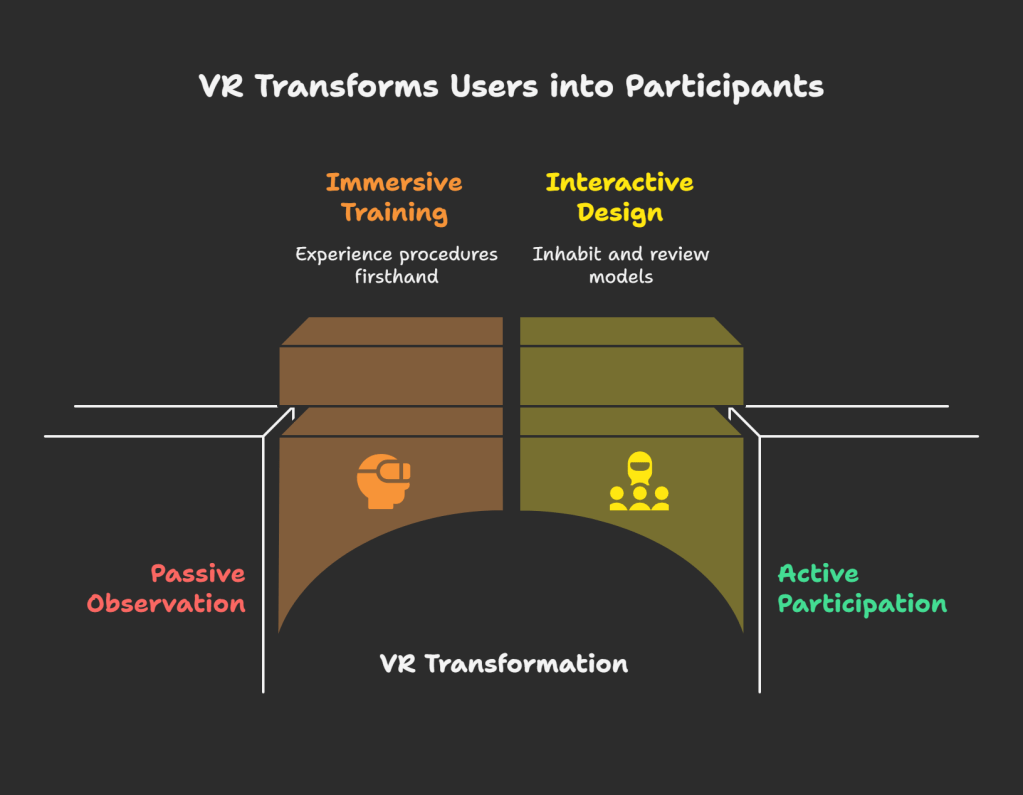
In the early 20th century, architects like Le Corbusier envisioned buildings as “machines for living.” Concrete structures designed to shape human behavior, productivity, and experience. Today, Virtual Reality offers something more ambitious: machines for feeling. Constructs not of steel and glass, but of perception, emotion, and immersion.
VR doesn’t just replicate reality; it reconstructs the boundaries of what experience means. And for organizations navigating competitive differentiation, this is not a novelty. It is a strategic opportunity to fundamentally reimagine how they train, design, communicate, and connect.
But the question is not whether VR is powerful. It demonstrably is. The question is whether your organization can deploy it without appearing desperate to be innovative, or worse, without understanding what the technology signals about your values and strategic priorities.
Why immersion is not enough
Most organizations adopt VR as an engagement tool. Impressive demos, memorable experiences, competitive differentiation. Few integrate it as a strategic communications platform.
The average deployment creates novelty, a virtual showroom, an immersive training module, a collaborative design space. But this, in truth, is surface-level adoption. Any agency can build it. The real work, the kind that transforms VR from gimmick to genuine competitive advantage, begins when organizations stop asking what can VR do and start asking what does our use of VR communicate about who we are.
This is where my work begins.
My approach does not rest in headset selection or content production. It begins in the narrative architecture you must construct: how VR integration aligns with your brand identity, how it enhances rather than complicates stakeholder relationships, and how it positions you as a thoughtful innovator rather than a trend-chaser. My role is not to implement VR; it is to ensure it amplifies your strategic credibility.
What you’re really paying for
You are not hiring a technology consultant. You are investing in strategic differentiation that survives scepticism.
I work at the intersection of immersive technology and stakeholder perception. That means anticipating cynicism before it undermines adoption. Identifying the gap between VR’s technical capabilities and what stakeholders will actually value. Translating virtual experiences into tangible business outcomes that boards, customers, and partners can understand and trust.
Where others focus on immersion, I architect legitimacy. Where others create experiences, I ensure those experiences reinforce rather than contradict your organizational identity.
The investment reflects the stakes: VR deployed without strategic coherence doesn’t just fail to deliver ROI, it positions you as technologically confused, disconnected from real business priorities, or desperate for relevance.
How it works
Strategic Alignment Assessment
I begin by evaluating why VR matters to your specific business context, not why it matters generally, but why it serves your competitive positioning, operational challenges, and stakeholder expectations. This includes analysis of your brand narrative, competitive landscape, and organizational readiness for immersive technology adoption.
Narrative Framework Development
Working collaboratively with your leadership, I develop communication strategies that frame VR within your broader strategic story. These frameworks translate technical capabilities into stakeholder value, showing investors why it’s strategic investment not vanity spending, showing customers why it enhances their experience, and showing employees why it supports rather than threatens their work.
Launch and Education Strategy
I provide comprehensive communication plans for VR rollout, internal messaging that builds enthusiasm and understanding, customer education that drives adoption without confusion, and media positioning that establishes thought leadership rather than technology following.
Ongoing Positioning Support
As your VR program matures, I remain available for advisory guidance, whether responding to stakeholder scepticism, pivoting messaging based on adoption data, or identifying opportunities to amplify success stories that strengthen your competitive positioning.
The risk you can’t afford to ignore
VR failures don’t arrive as technical glitches; they arrive as strategic embarrassments. A virtual training program that employees mock as ineffective doesn’t just underperform; it signals leadership disconnection from operational reality. A virtual showroom that customers find awkward doesn’t just fail to impress; it suggests your organization prioritizes novelty over genuine service improvement.
And in an environment where strategic credibility determines investor confidence and market position, these perceptions can undermine years of carefully constructed reputation.
What I offer is not just launch support. It is strategic insulation. The difference between adopting VR and integrating it meaningfully is subtle, but for organizations with established market positions, it’s the difference between innovation leadership and technology theatre.
VR is your vision made visible
The most sophisticated leaders are not those who chase technological trends. They are those who understand that every innovation choice is also a statement about judgment, priorities, and strategic clarity.
Virtual Reality is not a shortcut to engagement. It is a declaration of how you see the future of interaction, how you value experience over convenience, depth over efficiency, and human connection over transactional simplicity. If that declaration is unclear or misaligned with your core identity, stakeholders will question your judgment. If it is calibrated with precision, strategic intent, and authentic purpose, it becomes your most compelling evidence of visionary leadership.
Ready to discuss your VR strategy?
Contact me to schedule your complimentary initial consultation.
 Dissectra